
When you arrive in Japan as a foreign nurse, your first financial priority is usually the same: get a bank account open so your salary has somewhere to land. It sounds straightforward. In practice, it is one of the more friction-heavy tasks on the new arrival checklist, and the hanko requirement is often the part nobody warned you about.
Japan’s banking system still operates with the personal seal as a core verification tool. Depending on the bank, the branch, and sometimes the individual staff member you encounter, you may be asked to present a hanko as part of opening a new account. For nurses specifically, this tends to come up at the worst possible moment—right at the start of a new job, when you are already managing housing paperwork, hospital onboarding, and resident registration simultaneously.
This guide walks you through exactly where the hanko fits into bank account setup for foreign nurses in Japan, which documents it appears on, what type to order, and how to get it done in English without unnecessary delays. Getting this right early means your first salary arrives without complications.
Why This Segment Is Asked for a Seal
The hanko has been part of Japanese banking since long before electronic verification was a consideration. Traditionally, registering a personal seal with your bank—a process called inkan toroku at the branch level—was how the bank confirmed your identity for future transactions. Your registered seal impression, held on file, served as proof that you authorised withdrawals, transfers, or account changes.
In recent years, some banks have moved away from mandatory hanko requirements, particularly for basic savings accounts. Japan Post Bank and some branches of major city banks like SMBC and MUFG have begun accepting accounts opened without a seal in certain circumstances. However, the situation is inconsistent. Many branches still require one, rural post offices almost universally do, and some account types—including those tied to salary deposits for healthcare workers—may still have a hanko field on the enrollment form.
For foreign nurses, there is an additional layer. Your employer’s HR department often arranges or strongly recommends a specific bank for salary deposit, sometimes a local regional bank or credit union affiliated with the hospital. These institutions tend to be more traditional in their processes. A regional bank in a mid-sized city is far more likely to require a hanko than a city bank branch in central Tokyo.
The honest answer is that you cannot always know in advance whether a hanko will be required at your specific branch. What you can control is being prepared so the question never slows you down.
Common Documents and Timelines
For nurses setting up their financial life in Japan, the hanko appears across a cluster of documents that tend to arrive in the first few weeks. Here is a realistic picture of where it shows up:
At the bank:
- New account application form (kouza kaisestu moshikomisho) — hanko field is standard at most branches
- Seal registration card held on file by the bank (todokede-in)
- Direct debit authorization forms, if setting up automatic bill payments from the account
From your employer:
- Salary deposit designation form — submitted to HR, directs your wages to your new account; often requires a hanko to match the one registered at the bank
- Social insurance enrollment documents, which sometimes reference your bank details and carry a hanko field
From your ward office:
- Resident registration (juuminhyo application) — not always, but hanko fields appear on some ward forms and having one on hand avoids delays
A realistic scenario: your hospital’s HR team hands you a salary deposit form on day two of onboarding. The form has a hanko field. Across town at the bank branch your employer recommended, the account application also has a hanko field. Both want the same seal—a consistent personal mark they can cross-reference. If you ordered your hanko before arriving, this is a five-minute task. If you did not, you are making an extra trip.
A second scenario: you open a basic account at Japan Post Bank (Yucho), which in many cases no longer requires a hanko. But your hospital’s HR uses a regional bank, Shizuoka Bank or Hiroshima Bank or similar, and their process is entirely different. The rule is to prepare for the stricter requirement.
If you are still looking for the right role, ComfysCareer is a solid starting point for foreigner-friendly jobs in Japan.
Common mistakes at this stage:
- Assuming Japan Post Bank’s relaxed policy applies everywhere. It does not. Policies vary by bank, branch, and account type.
- Arriving at the bank without a hanko and attempting to substitute a handwritten signature. Some banks will allow it; many will ask you to come back with a seal.
- Registering a borrowed hanko with your bank. This creates a traceability problem and is not advisable. The seal registered at your bank should be uniquely yours.
- Using a 100-yen shop (hyaku-en shoppu) stamp. These are mass-produced and not accepted by banks as personal seals. Banks require a carved, individual inkan.
- Ordering a hanko that does not match your registered name. Your bank account name, residence card, and hanko should all be consistent.
Recommended Hanko Type and Size
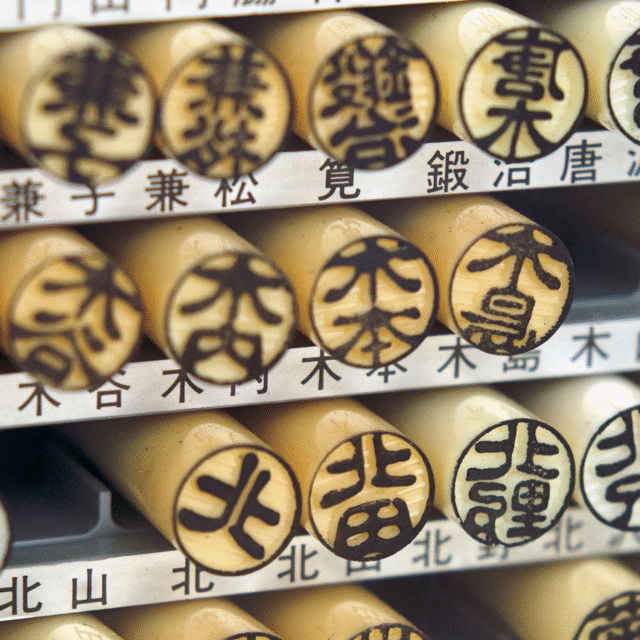
For bank account setup, a mitome-in (認め印) works in most everyday banking situations, but there is an important nuance worth understanding.
Some banks—particularly for higher-value accounts or specific account types—ask for a jitsuin (実印), a seal that has been formally registered with your local ward office. However, for standard salary deposit accounts and everyday banking, a personal seal that has not been formally registered is typically accepted. The bank registers it on their own internal system rather than relying on the ward office record.
Size: 10.5mm to 12mm is the standard range. For banking purposes, 10.5mm or 11mm fits cleanly in document fields and is considered appropriately professional.
Material: For a seal you will use regularly—and a bank-registered seal does get used whenever you update account details, close an account, or authorize certain transactions—a more durable material is worth the modest extra cost. Resin and acrylic options are perfectly functional, but Japanese cherry wood (yamato) or black buffalo horn (tsuno) hold up better over years of use.
Name format: This is critical for banking. Your hanko must match the name on your bank account, which in turn should match your residence card. For foreign nationals, this means katakana in most cases. If your name is registered as Sarah Thompson in your official documents, your bank account and hanko should reflect the same katakana rendering: サラ・トンプソン or a close equivalent.
Confirm the exact katakana spelling before ordering. Small variations in how foreign names are rendered phonetically can cause problems if the bank’s record and your hanko do not match precisely.
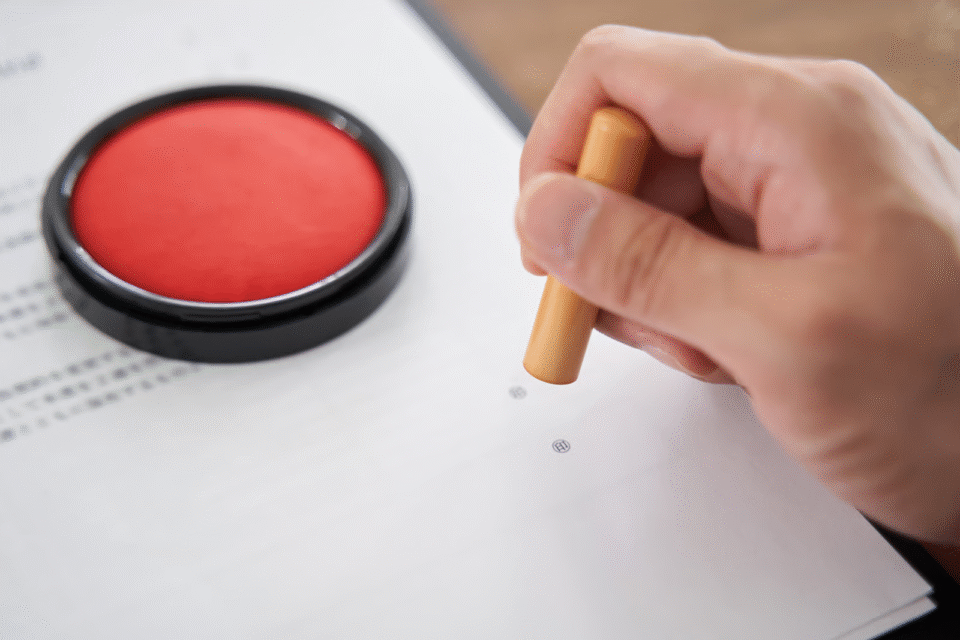
Ink pad: Banks typically stamp your seal impression onto the registration card using vermillion (shuniku) ink. Make sure your hanko comes with or is used alongside a proper vermillion ink pad, not a standard office stamp pad.
Ordering Tips in English
HankoHub offers a fully English-language ordering process, which removes the main barrier that foreign nurses run into when trying to order locally or through Japanese-only websites.
The process is direct: enter your name, choose your script (katakana for most foreign nationals), select size and material, confirm the design preview, and place your order. No Japanese language ability required at any point.
Practical tips for ordering ahead of bank account setup:
- Order before you travel or immediately on arrival. If you have a confirmed hospital start date, order at least two weeks in advance. Bank account setup typically happens in the first week of employment, and you want the hanko in hand before that appointment.
- Match the name exactly to your residence card. This is the document the bank will ask for, and the katakana on your hanko needs to align with it.
- Request a design preview before confirming. HankoHub provides this, and it is worth using to verify the layout and name rendering before production.
- Keep a note of the seal design on file. If you ever lose your hanko, having a record of the original design helps when ordering a replacement that needs to match bank records.
- Order one dedicated hanko for official use. Some nurses keep a second hanko for casual everyday use—signing delivery receipts, internal hospital forms—and reserve the clean, well-inked version for banking and legal documents.
If you are uncertain how your name should be written in katakana, HankoHub can assist with the conversion as part of the ordering process.
FAQ
Do all Japanese banks require a hanko to open an account? Not all, but many do. Japan Post Bank has relaxed its requirements in many branches, and some city banks offer seal-free account opening for basic accounts. However, regional banks and credit unions—which are common salary deposit options for hospital-employed nurses—often still require one. Preparing a hanko before your banking appointment is the safest approach.
Can I use my hanko from home country? No. A hanko is a specifically Japanese personal seal, carved to display a name in Japanese script or, less commonly, romaji. Seals from other countries are not accepted in Japanese banking contexts.
What happens if I lose my registered hanko? You need to notify your bank promptly and go through a seal change procedure (inkan henko tetsuzuki). This involves submitting new identification, a new seal registration, and in some cases a waiting period before the new seal is active. It is a manageable process but an inconvenient one, which is why keeping your bank-registered hanko somewhere secure matters.
Can I register a different hanko with my bank later? Yes. The seal change procedure allows you to update your registered hanko. You will need to visit the branch in person with your residence card and new seal.
My hospital is arranging the bank account for me. Do I still need a hanko? Possibly. Some hospitals handle the paperwork on your behalf for the initial setup, but you may still need to sign or stamp certain forms. Ask your HR contact specifically whether a hanko is required and, if so, what name format they recommend. Do not assume it is taken care of until you have confirmed it.
Is a digital hanko (denshi inkan) accepted at banks? Not for in-person account setup at most branches. Digital seals are increasingly used in corporate and administrative settings, but retail banking in Japan remains primarily paper-based. A physical hanko is what you need for branch-level transactions.
Next Steps

Before your first banking appointment in Japan, take five minutes to sort your hanko. Head to HankoHub, enter the name exactly as it appears on your residence card, choose a size and material suited to regular official use, and place your order. Having your seal ready before you walk into that branch appointment removes one of the more common friction points that foreign nurses run into in their first weeks.