

Most foreign researchers arrive in Japan prepared for the big paperwork moments — the employment contract, the lease agreement, the bank account setup. What catches people off guard is everything that comes after. The steady, ongoing stream of forms, approvals, and declarations that make up daily administrative life at a Japanese research institution. And in many of those moments, a hanko is expected.
Daily admin in a Japanese research context is not a one-time event. It recurs throughout your posting — monthly expense claims, equipment loan forms, conference travel approvals, library borrowing agreements, procurement requests. These are not dramatic legal documents, but they are real, they are frequent, and they commonly include a seal field. If you are borrowing a colleague’s hanko every time one appears, or leaving fields blank and hoping no one notices, you are creating small friction points that add up over the course of a contract.
This guide focuses specifically on the daily admin layer of researcher life in Japan. Not onboarding, not housing — but the routine institutional paperwork that continues long after you have settled in. You will understand why a personal seal matters in this context, which document types tend to come up most often, and how to get the right hanko sorted before any of it becomes a problem.
Why This Segment Is Asked for a Seal

The hanko for researchers in Japan question tends to get answered once — during onboarding or housing setup — and then quietly forgotten. But the reality is that Japanese research institutions use seal impressions as a routine authorization tool across a wide range of internal processes, not just formal contracts.
The underlying logic is consistent with how hanko functions elsewhere in Japanese administrative life. A seal impression on a document creates a named, traceable record of personal authorization. In institutional settings, this applies not just to employment contracts but to any internal process where individual accountability needs to be recorded. When a researcher signs off on a procurement request, approves a lab visit, or claims reimbursement for field research expenses, the institution wants a clear mark that this specific person reviewed and authorized this specific action.
For foreign researchers, this creates a recurring practical issue. You may have navigated onboarding successfully — perhaps with a borrowed seal or an institution that accepted signatures for the main contract — without ever acquiring your own personal hanko. That works once. It does not work well over a two or three-year posting when administrative touchpoints come up regularly.
There is also a professional dimension that matters in Japanese institutional culture. Research environments in Japan, whether at national universities, private institutes, or government-affiliated labs, tend to place genuine weight on procedural correctness. Consistently arriving at administrative moments without your own seal — or visibly improvising — creates a low-level impression of unpreparedness that is worth avoiding. It is not career-defining, but it is noticed.
Consider this scenario: a postdoctoral researcher from Canada is eight months into a two-year contract at a private research institute. She has been getting by without a hanko by signing forms and relying on her supervisor to cosign where a seal is required. Her supervisor is patient, but the arrangement means every administrative task requires a coordination step that would otherwise be unnecessary. When her supervisor takes a month of research leave, the routine breaks down entirely and two reimbursement claims sit unprocessed for three weeks. Her own hanko would have made all of this self-contained.
Common Documents and Timelines
Unlike the concentrated burst of paperwork during onboarding, daily admin documents arrive continuously and unpredictably throughout your posting. The specific forms vary by institution, but the following types come up regularly across most research environments in Japan.
Expense reimbursement claims are among the most frequent. Travel to conferences, field research costs, equipment purchases made out of pocket — all of these typically require a claim form with a hanko field. These forms are often processed monthly and follow fixed submission deadlines. Missing a deadline because you do not have a seal ready is a minor but entirely avoidable frustration.
Equipment and facility loan agreements come up whenever you borrow institutional equipment — cameras, measurement tools, lab instruments, vehicles — for research use. These short-term loan agreements commonly include a seal field as the borrower’s authorization mark.
Conference and travel approval forms are required at many institutions before a researcher can attend external events on institutional time or funding. The approval workflow often passes through a department head or administrative office and includes hanko fields at each authorization step.
Library and archive borrowing agreements at university libraries and research institute collections sometimes require a seal for extended loan arrangements or access to restricted materials.
Internal research project documentation — progress reports, budget allocation requests, collaboration agreements between labs — varies widely by institution but commonly uses hanko fields for researcher sign-off.
Delivery and receipt acknowledgments for equipment, reagents, and materials ordered through institutional procurement often require a seal at the point of receipt.
The timeline for these documents is ongoing rather than front-loaded. You may go two or three weeks without needing your hanko, then encounter three forms in a single day. Having the seal on hand at all times — in a consistent place, with an ink pad — is more practical than treating it as something you retrieve for specific occasions.
Common mistakes researchers make in daily admin:
- Leaving hanko fields blank and assuming someone will follow up, which creates incomplete records that administrative staff have to chase.
- Relying on a supervisor or senior colleague to provide a seal, which introduces a dependency that creates delays whenever that person is unavailable.
- Using different seals at different times — a borrowed one here, a generic one there — which creates inconsistent impression records that can cause confusion during audits or contract renewals.
- Keeping the seal in a drawer at home rather than in a bag or desk, meaning it is never actually available when needed.
- Ordering a seal that is too large or too formal-looking for everyday institutional documents, which occasionally prompts unnecessary questions from administrative staff.
Recommended Hanko Type and Size
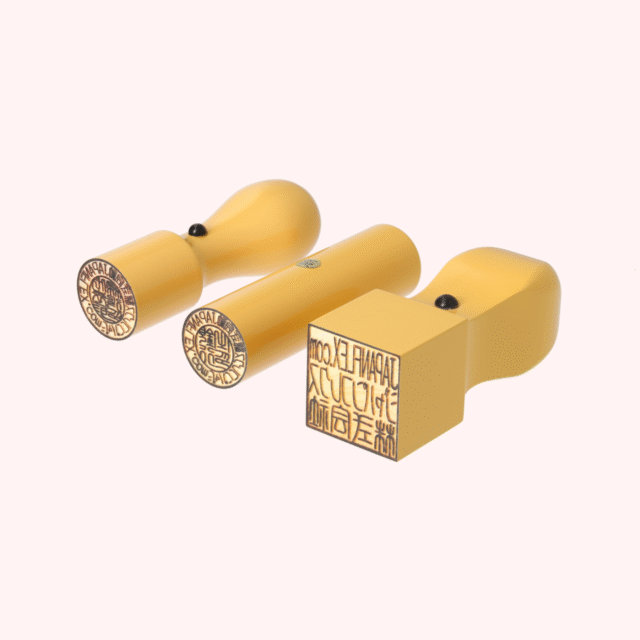
For daily admin use in a research setting, a mitomein is the right tool. This is a personal everyday seal, used without formal registration, and it covers the full range of routine institutional documents a researcher encounters — expense claims, equipment loans, travel approvals, internal project forms, and receipt acknowledgments.
There is no need for a jitsuin (registered seal) for this category of documents. Registered seals are reserved for high-stakes legal transactions — property purchases, certain financial agreements — that fall well outside the scope of routine research admin. Using a jitsuin for everyday institutional paperwork is not incorrect, but it is unnecessarily formal and creates extra administrative steps if you ever need to update or replace the seal.
A ginkoin (bank seal) is a separate consideration tied to your Japanese bank account, not to institutional admin. Some researchers use the same seal for bank and everyday purposes; others keep them separate. For daily admin specifically, your mitomein is sufficient.
On size: 10.5mm or 12mm in diameter is the standard for personal everyday seals. This is what administrative staff expect to see on individual documents. Anything larger reads as a business or corporate seal and can cause minor confusion in personal admin contexts.
On material: since a daily admin seal gets used frequently over a multi-year posting, a mid-range material is worth the modest additional cost. Resin seals are functional but can show wear over time. Acrylic, buffalo horn, or titanium options are more durable and hold impression clarity better with regular use.
On name: use the name that appears on your residence card and institutional employee records. For foreign names, katakana is entirely standard and universally accepted in institutional admin contexts across Japan. The seal does not need to use kanji to be taken seriously.
One practical addition worth considering: a shachihata (self-inking stamp) as a supplement to your carved seal. Shachihata stamps are fast, require no separate ink pad, and are widely used in Japanese offices for low-stakes daily documents. Some administrative offices accept them readily for routine approvals; others require a proper carved seal for anything official. Having both covers you across the full range of daily admin scenarios.
Ordering Tips in English
Getting a hanko ordered correctly as a foreign researcher comes down to a few specific decisions made at the ordering stage.
Order before your posting begins if possible. For researchers already in Japan without a hanko, order as soon as you recognize the gap. Waiting for a specific document to force the issue means you have already missed the optimal window.
Be precise about name rendering. When ordering in katakana, confirm that the phonetic rendering matches how your name appears on official institutional documents. If your HR office has already romanized your name in a specific way, use that as the reference for your katakana conversion. Inconsistencies between your seal and your official records — even minor ones — can cause unnecessary questions during document processing.
Choose a readable, standard font. Decorative fonts on hanko can make impression marks difficult for administrative staff to read and verify. A clean, standard font is always the right choice for a working seal used on institutional documents.
Keep a dedicated ink pad with the seal. Vermilion ink is the standard color for personal seals in Japan. A flat, well-maintained ink pad produces clean, legible impressions. A dried-out or overloaded pad creates impressions that administrative offices sometimes flag as unclear. Replace or refresh the ink pad when impressions start to look inconsistent.
Store the seal somewhere accessible. The most useful seal is the one that is actually with you when a form appears. A small case in your regular bag, or a fixed spot in your desk drawer, means you are never running back to your apartment to retrieve it before an administrative deadline.
If you’re still looking for the right role, ComfysCareer is a solid starting point for foreigner-friendly jobs in Japan.
HankoHub offers an English-language ordering process that handles the katakana conversion for foreign names and explains the available options clearly for people who are not already familiar with hanko types. For a researcher who wants a practical, correctly formatted everyday seal without navigating a Japanese-only interface, it is a straightforward option.
FAQ
I managed onboarding without a hanko. Do I really need one for daily admin? Technically, some institutions will continue to accept signatures or find workarounds. Practically, having your own seal makes every recurring admin task self-contained. Over a two or three-year posting, the convenience accumulates significantly. It also removes the dependency on colleagues or supervisors to provide a seal on your behalf.
Can I use a shachihata instead of a carved hanko? For many low-stakes daily documents — internal approvals, receipt acknowledgments, routine sign-offs — a shachihata is accepted. For more formal institutional documents, a carved seal is typically expected. Having both is a practical combination for a researcher’s daily admin life.
My institution says signatures are fine. Should I still get a hanko? If your institution accepts signatures for all documents, you may never strictly need one. But many institutions that accept signatures for formal contracts still have hanko fields on subsidiary forms processed by different departments or administrators. A personal seal covers those gaps without requiring you to investigate each form individually.
How do I know if a form requires a jitsuin versus a mitomein? For daily admin documents at research institutions, a mitomein is almost always sufficient. A jitsuin is specifically required for legal transactions that involve official seal certificates (inkan shomeisho). If a document requires that certificate, the requesting party will tell you explicitly. Standard institutional forms do not require it.
What if I lose my hanko mid-contract? Order a replacement promptly. Notify your bank if the lost seal was registered as your bank seal. For everyday institutional use, there is no formal deregistration process — simply begin using the replacement. If any ongoing documents have the old impression on record, inform the relevant administrative office.
Is a digital hanko useful for daily admin? Some research institutions in Japan have introduced digital approval workflows, particularly for internal communications and email-based sign-offs. A digital hanko can be useful in those contexts. However, most physical documents — printed forms, paper-based procurement requests, physical loan agreements — still require a physical seal impression. A digital hanko supplements but does not replace the physical version for most daily admin purposes.
Next Steps

If you are already into your research posting in Japan and handling daily admin without your own hanko, the gap is worth closing sooner rather than later. Visit HankoHub to order a personal everyday seal in English, confirm the katakana rendering of your name, and have a working seal ready for the next form that lands on your desk. It is a small thing to sort, and once it is done, every routine admin moment from that point forward becomes straightforward.