
One of the first practical questions foreigners face in Japan is deceptively simple: how do you write your name here? Not in a poetic sense — in a bureaucratic one. Your name in Japanese script will appear on your bank account, your employment contract, your apartment lease, and, if you order one, your hanko. Getting it right — or at least consistent — matters more than most people realize when they first arrive.
How to write your name in katakana is the core skill behind all of this. Katakana is the phonetic script Japan uses for foreign words and foreign names. It does not translate meaning; it approximates sound. That approximation is where things get interesting, because English phonetics and Japanese phonetics do not map cleanly onto each other, and the same foreign name can be rendered in katakana in several different ways, all of them technically defensible.
This guide walks through how katakana works for foreign names, how common name patterns translate, what to do with long or complex names, and — critically — how your katakana name choice affects your hanko. If you are setting up life in Japan, this is not a casual cultural exercise. It is a practical decision with real administrative consequences.
If you are job hunting, ComfysCareer‘s career guides can help you align your name spelling across resumes and onboarding documents.
Katakana Basics (Fast Primer)
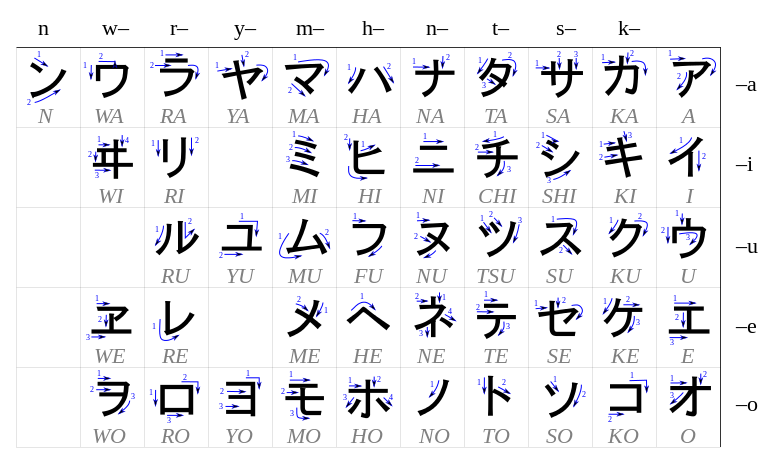
Katakana is one of Japan’s three writing systems, alongside hiragana and kanji. Where kanji are complex characters with meaning, and hiragana is the flowing script used for Japanese grammatical elements, katakana is a crisp, angular phonetic system used primarily for foreign loanwords, foreign names, and emphasis.
There are 46 base katakana characters, each representing a syllable — not an individual letter. This is the key point for understanding why your name in katakana may look or sound slightly different from how you are used to seeing it. Japanese syllables follow a specific pattern: most consist of a consonant followed by a vowel (ka, ki, ku, ke, ko), with a small number of exceptions. English names, which often end in consonants, include consonant clusters, and use sounds that do not exist in Japanese, require adjustment when converted.
The sounds that do not exist in Japanese phonetics include:
- The English “L” sound — approximated with the Japanese “R” (ラリルレロ), which itself sits between an English L and R
- The “V” sound — approximated with “B” in traditional usage, though ヴ (vu) is increasingly used
- The “TH” sound — approximated with “S” or “Z” depending on pronunciation
- Final consonants — Japanese syllables rarely end in a consonant (only “N” is an exception), so a name ending in a consonant typically gains a vowel sound at the end
The elongated vowel mark (ー) is used in katakana to extend a vowel sound. It appears in many foreign name transcriptions — for instance, “Baker” becomes ベーカー (Bēkā), where both the long E and the final R-approximation use the mark.
Understanding this system does not mean you need to memorize all 46 characters before making any decisions. It means you need to understand that your katakana name is a phonetic approximation, that multiple versions may be valid, and that once you choose one, consistency matters.
Common Name Patterns
Most common Western names have established katakana conventions that are widely recognized and accepted. The following examples show how the phonetic logic plays out in practice.
Single-syllable names:
- Mark → マーク (Māku) — the long vowel mark extends the A, the K gains a U
- James → ジェームズ (Jēmuzu) — J approximated with JE, final S becomes ZU
- Claire → クレア (Kurea) — CL cluster split, final R dropped
Two-syllable names:
- David → デイビッド (Deibiddo) — V approximated with B, final D doubled with a small tsu then DO
- Sarah → サラ (Sara) — relatively clean conversion, final H silent
- Rachel → レイチェル (Reicheru) — CH becomes CHE, final L becomes RU
Three-syllable names:
- Jessica → ジェシカ (Jeshika) — straightforward conversion, JE for J
- Matthew → マシュー (Mashū) — TH becomes SH by convention, long U at end
- Natalie → ナタリー (Natarī) — L becomes R, long I at end
Names with sounds that require approximation:
- Laura → ローラ (Rōra) — L becomes R throughout, long O
- Victoria → ビクトリア (Bikutoria) — V becomes B, otherwise clean
- Ethan → イーサン (Īsan) — TH becomes S, long I opening
Micro-scenario: Tom moved to Kyoto and assumed his name in katakana was トム (Tomu). When his bank card arrived, it read トーム (Tōmu) — with a long O — because the branch staff had used a slightly different convention. His HR documents used トム. His hanko was ordered as トム. For most daily purposes this caused no real problem, but when he later needed his name to match exactly across official documents, the inconsistency required an explanation. The lesson: decide on your katakana name early and use it consistently everywhere.
Long Names and Abbreviations
Long foreign names present a particular challenge in Japan. Official documents, name fields on forms, and hanko seals all have practical space constraints. A name like “Christopher” (クリストファー, Kurisutofā, seven katakana characters) or “Alexandria” (アレクサンドリア, Arekusandoria, eight characters) may need to be handled thoughtfully depending on context.
For official documents — residence registration, bank accounts, employment contracts — you should use your full legal name as it appears in your passport, converted into katakana as completely as possible. Abbreviating without good reason on official paperwork can cause mismatches that become problems later.
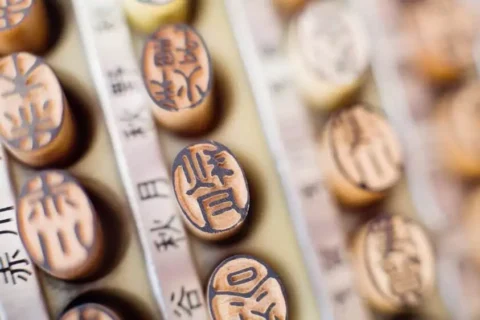
For hanko, the practical constraints are more real. A hanko seal has a fixed diameter, and the characters must fit readably within it. Most foreign names in katakana fit comfortably on standard-sized seals of 13.5mm to 16.5mm diameter. Very long names may require either a slightly larger seal, a two-line layout, or a considered abbreviation.
Common approaches for longer names:
- Use your commonly used first name rather than a full formal name (Christopher → Chris → クリス, Kurisu)
- Use surname only, which is also standard for hanko in Japan
- Discuss layout options with the seal maker — a reputable service will advise on what fits cleanly and what does not
Surnames in katakana tend to be more straightforward than given names because many common Western surnames follow regular phonetic patterns. Smith becomes スミス (Sumisu), Johnson becomes ジョンソン (Jonson), Williams becomes ウィリアムズ (Wiriamuzu).
Common mistakes with long names: Foreigners sometimes make an informal abbreviation — using “Alex” on some documents and “Alexandria” on others, for instance — without realizing that official documents need to match. Before abbreviating for convenience, confirm with your ward office, bank, or HR department that the shortened version is acceptable for their specific purposes.
Katakana for Banks and Contracts
Japanese name writing in a banking and legal context is not optional or stylistic — it is the official record of who you are in Japan’s administrative systems. Your katakana name is used on your bank account, linked to your Residence Card registration, and may appear on your lease agreement and employment contract. Inconsistency between these documents can cause friction that is disproportionate to the original mistake.
At the bank, your name is recorded in katakana exactly as you provide it at the time of account opening. This becomes your official account name. When your employer sets up salary transfers, they will enter this exact string of characters. A mismatch — even a single character difference, such as a long vowel mark included in one place and absent in another — can cause a transfer to fail or require manual correction.
On apartment leases and contracts, your name in katakana appears alongside your Residence Card details. Real estate agents and property management companies typically derive the katakana from your passport name or from what you provide directly. Confirm the spelling before signing — corrections after the fact require a revised document and sometimes a new seal.
On employment onboarding documents, your katakana name is used for payroll, tax withholding, social insurance registration, and internal HR systems. Many companies ask you to write it yourself on forms. Others will have a staff member attempt the conversion from your legal name. Neither approach is foolproof. It is worth having your preferred katakana name written down before your first day — even just on a piece of paper — so you can provide it consistently without variation.
Micro-scenario: Anna’s legal name was “Annalise.” At the ward office, staff registered her as アナリス (Anarisu). At her company, HR wrote アンナリーズ (Annarīzu). Her bank used アナリーズ (Anarīzu). Three documents, three versions. When she later needed to confirm her identity across these records for a lease application, she had to produce all three with an explanation. One consistent katakana name, established at registration and carried forward, would have prevented the entire situation.
Katakana for Your Hanko
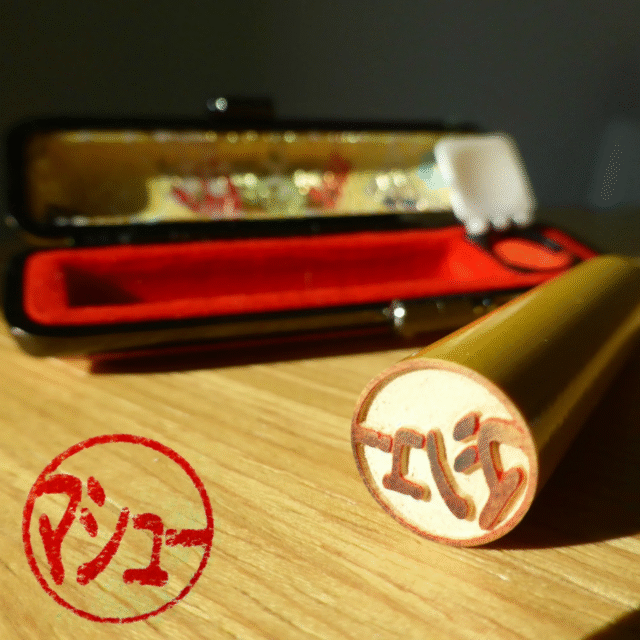
The decision about which katakana rendering to use for your katakana hanko is one of the more consequential small decisions you will make when setting up life in Japan. Once a hanko is made and registered — at a bank or at city hall — the characters on that seal are the official characters. Changing them later means ordering a new seal and re-registering it.
The main decisions you are making:
1. Which rendering of your name to use If your name has multiple plausible katakana versions — and many do — decide which one matches what you have used or plan to use on official documents. The katakana on your hanko should match the katakana on your bank account and your residence registration.
2. First name, surname, or both In Japan, hanko traditionally carry the surname only. For foreigners, either surname or given name is generally accepted, and the choice often comes down to how you are identified in your specific context. If your workplace knows you by your first name and your HR documents use your first name in katakana, a given-name hanko may be more practical for daily use. If your official documentation emphasizes your surname, a surname hanko aligns better with formal and legal use.
3. Katakana versus romaji Romaji (Latin letters) is accepted at most banks and city halls for foreign national hanko. Some foreigners prefer it for clarity. Katakana remains the more conventional choice and is slightly more widely accepted across different institutions and contexts. If you are uncertain, katakana is the safer default.
4. Seal size and its relationship to character count Longer katakana names need either more space or a layout adjustment. Standard ginko-in seals run 13.5mm to 16.5mm in diameter. A name that runs to six or seven katakana characters at that size is readable but worth reviewing in a preview before ordering. A two-line layout — first name above surname, or a name split across lines — is another option for longer combinations.
The risk of getting it wrong is not catastrophic, but it is genuinely inconvenient. A seal that does not match your registered katakana name will be rejected at the bank or at city hall. A seal that is too small for official registration will need to be replaced. A seal with an unconventional or inconsistent rendering may prompt questions at institutions that cross-check against your Residence Card.
HankoHub offers format guidance as part of the ordering process — they work with foreign names specifically, advise on katakana rendering, and produce seals sized correctly for the intended use. For a decision where the details matter this much, that kind of guidance is worth using.
FAQ
Is there one correct way to write my name in katakana?
Not always. Many foreign names have more than one defensible katakana rendering. What matters most is choosing one version and using it consistently across all official documents — residence registration, bank records, employer HR systems, and your hanko.
Can I use romaji on my hanko instead of katakana?
Yes, romaji is accepted at most banks and city halls for foreign national seals. Katakana is more conventional and slightly more broadly accepted, but romaji is a legitimate choice, particularly if your name in katakana is unusually long or prone to inconsistent rendering.
What if my name was already registered in katakana at my ward office and I want to use a different version on my hanko?
Use the version that matches your ward office registration for any official hanko — particularly your jitsu-in (registered seal) and ginko-in (bank seal). Consistency between official documents is more important than which version you personally prefer.
How do I know what size hanko to order for banking versus city hall registration?
Ginko-in (bank seals) commonly range from 13.5mm to 16.5mm in diameter. Jitsu-in (city hall registered seals) have specifications that vary slightly by municipality. A reputable hanko service will advise on the correct size for your intended use.
My name is very long in katakana. What are my options?
The most common approaches are: use a shortened version of your name that is also used on official documents, use your surname only, or order a slightly larger seal that accommodates the full name. Discuss layout options with the seal maker before finalizing.
Does the katakana on my hanko need to match my passport name exactly?
It needs to match the katakana name recorded in official Japanese administrative records — your ward office registration and your bank account. These are derived from your passport name but may not be character-for-character identical depending on how the conversion was handled. Confirm what is on your official records and match that.
Next Steps

Your katakana name is a practical identity in Japan — not just a curiosity. It follows you through banking, employment paperwork, lease agreements, and anywhere a seal is required. Taking a few minutes to establish one consistent version now prevents the kind of document mismatches that create real friction later.
When you are ready to order your hanko, HankoHub provides format guidance through the process — helping you confirm the right katakana rendering, choose between first name, surname, or combined formats, and get the sizing right for your intended use. For a step where small decisions have lasting administrative consequences, that guidance makes a meaningful difference.