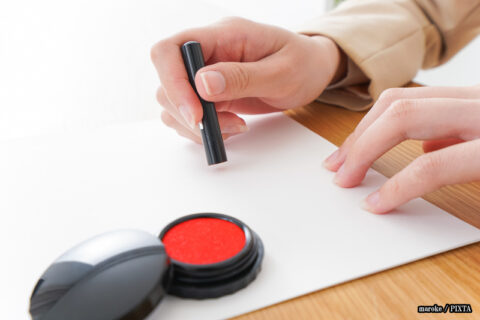


Japan is one of the world’s leading destinations for academic and scientific research. Universities, national institutes, private R&D labs, and government-funded research centers attract foreign researchers from every field — and nearly all of them, at some point in their first week, get handed a form and asked for their hanko.
Hanko for researchers in Japan is not a bureaucratic footnote. It sits at the center of how Japanese institutions formalize agreements, process employment, and manage the administrative side of research life. For foreign researchers arriving under fixed-term contracts, fellowship agreements, or postdoctoral appointments, the hanko requirement appears early and often — and not being prepared for it creates delays that ripple through your first month.
This guide covers the practical reality: why researchers specifically are asked for a seal, which contracts and documents require one and when, what type of hanko fits the research context, and how to order one in English without navigating a Japanese-language shop. It’s written for researchers who are newly arrived, mid-contract, or preparing to relocate and want to get this sorted before it becomes an issue.
Why This Segment Is Asked for a Seal
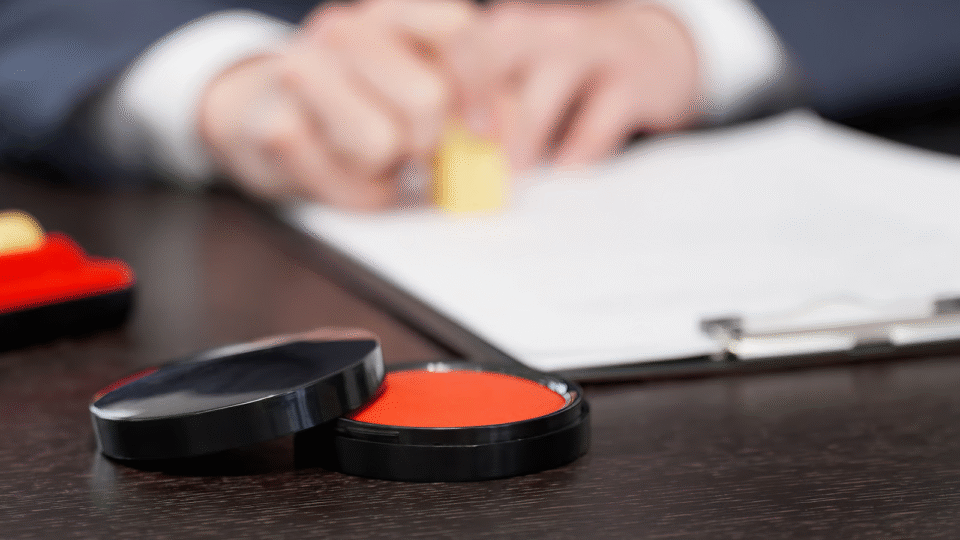
Research institutions in Japan — whether national universities, private universities, RIKEN, JST-affiliated centers, or corporate R&D divisions — run on the same administrative infrastructure as the broader Japanese employment system. That infrastructure is built around the hanko.
When a foreign researcher joins an institution, the HR and contracts office processes them through the same documentation framework as any Japanese employee or affiliated researcher. Employment contracts, grant agreements, IP assignment clauses, equipment loan forms, and internal approvals all use the hanko as the standard sign-off. At most institutions, a signature is not automatically equivalent. It may be accepted as an exception, with additional steps and approvals, but it is not the default.
The research sector adds its own layers on top of standard employment paperwork. Grant disbursement forms, co-investigator agreements, ethics board submissions, and equipment procurement requests often require a seal from each named researcher. If you’re on a joint project with Japanese colleagues, being the only person without a hanko can slow down approvals that affect the whole team.
There’s also a contractual dimension specific to fixed-term and fellowship positions. Many foreign researchers in Japan are on one- to three-year contracts that are renewed annually or tied to specific grant cycles. Each renewal, each amendment, and each new project agreement typically requires a fresh round of signatures — and in Japanese institutional practice, that means hanko.
Micro-scenario: David, a postdoctoral researcher from Germany at a national university in Tsukuba, arrived two weeks before his appointment officially started. His contract signing was scheduled for day one. He hadn’t ordered a hanko, assumed a signature would work, and spent his first three days waiting for an exception to be approved through two administrative layers. His lab access card was delayed as a result.
Common Documents and Timelines
Researchers in Japan encounter hanko requirements across several distinct phases — from initial contract through ongoing project administration.
At appointment or contract signing:
- Employment or appointment contract
- Researcher affiliation agreement
- Intellectual property and confidentiality clauses
- Laboratory rules and safety acknowledgment forms
- Visa support documentation at some institutions
During the first week of onboarding:
- Social insurance enrollment (health insurance and pension)
- Tax withholding declaration
- Bank account registration for salary or stipend payments
- Commuter or housing allowance applications
- Institutional ID and access card registration forms
During ongoing research and project administration:
- Grant application supporting documents
- Co-investigator or sub-investigator agreements
- Equipment loan and return forms
- Procurement and expense reimbursement requests
- Ethics committee application forms
- Conference or travel approval forms
- Annual contract renewal paperwork
The first week carries the highest concentration of hanko requirements. Most institutions expect onboarding paperwork complete within three to five business days. If your seal isn’t ready, you’ll need to ask the contracts office about temporary signature arrangements — most will accommodate this, but it creates extra steps and sometimes delays salary processing or system access.
Checklist — confirm these with your institution’s HR or contracts office before arrival:
- Is a hanko required for the appointment contract, or is a signature accepted?
- Which forms specifically require a seal?
- Is there a preferred size or format?
- Should the name be in katakana, kanji, or is romaji acceptable?
- Does the institution have a preferred vendor, or can you order independently?
- Are there any grant-specific documentation requirements regarding seal format?
Common mistakes:
Waiting until after arrival to order. Lead times for custom hanko, even from fast online services, are typically several business days. If you’re arriving directly into contract signing, order at least two weeks in advance.
Assuming your institution is flexible because it’s international. Even universities with large foreign researcher populations and English-language HR departments often default to hanko on official documents. The international-facing surface of an institution doesn’t always reflect its internal administrative requirements.
Ordering a full name seal when a surname-only seal is sufficient. Most researchers in Japan use a surname-only mitome-in for daily admin. Confirm what your colleagues and HR expect before committing to a name format.
Recommended Hanko Type and Size
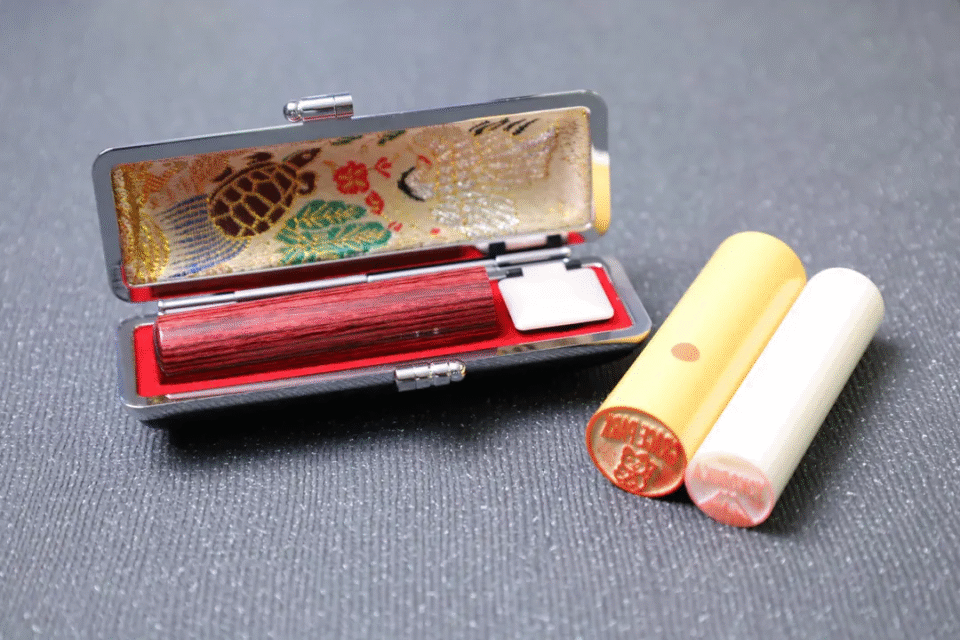
For research contracts and daily institutional admin in Japan, the practical choice is a mitome-in (認め印) — a personal everyday seal used for standard administrative and employment documentation. This is distinct from a jitsuin (実印), which is a formally registered seal used for major legal transactions such as property purchases or large financial agreements. The overwhelming majority of research-related paperwork requires a mitome-in, not a jitsuin.
Size: The standard range for a personal mitome-in is 10.5mm to 12mm in diameter. An 11mm seal is the most common and fits cleanly on standard form fields used in Japanese institutional paperwork. Larger sizes can be awkward on smaller form boxes; smaller sizes can be harder to ink consistently.
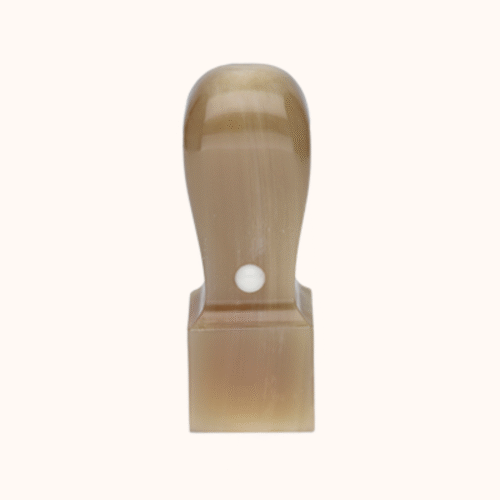
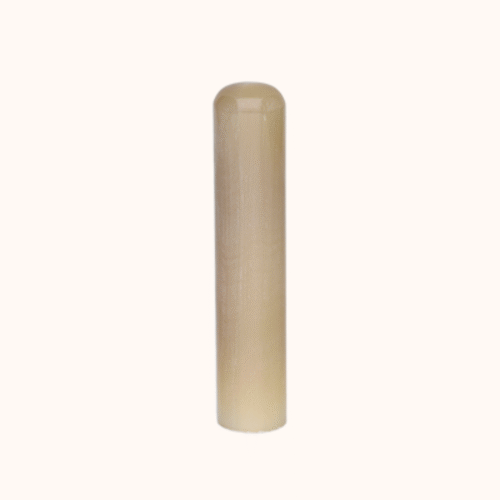
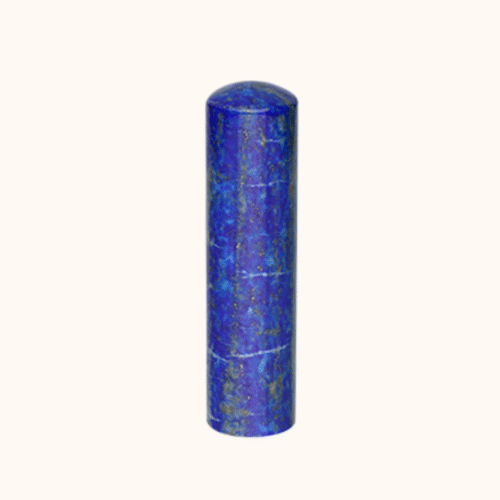
Material: For a work hanko used on contracts and admin forms, durability and clean impression matter more than material prestige. Resin, acrylic, and wood composite options are all entirely appropriate for a mitome-in at this level.
Name rendering for foreign researchers:
- Katakana: The most reliable option for foreign names. A katakana rendering of your surname — スミス, ミュラー, キム — is standard, widely understood, and accepted across virtually all Japanese institutions. This is the recommended default if your institution has no stated preference.
- Kanji: If your name has a recognized kanji rendering, or if you’ve been using a Japanese name professionally, this is equally valid. Some researchers with East Asian names that translate directly to kanji choose this option.
- Romaji: Accepted at many private universities and corporate R&D environments, particularly those with international orientations. Less consistent at national universities and government-affiliated research institutes. If you’re unsure, katakana is the safer choice.
Micro-scenario: Yuna, a researcher from South Korea at a private university in Tokyo, ordered a katakana mitome-in before her fellowship began. She used it for her appointment contract, her bank account setup, and her first grant disbursement form without any issues. One seal, used across three separate administrative contexts in her first month.
On the digital side: a small number of Japanese research institutions have begun piloting electronic approval systems that support digital seal equivalents. If your institution uses a document management platform, it’s worth asking whether digital hanko are accepted for internal approvals. For formal contracts and external-facing documents, however, a physical mitome-in remains the standard at most institutions.
Ordering Tips in English
The practical barrier for most foreign researchers is the ordering process itself. Traditional hanko shops — the kind near university gates or train stations — operate in Japanese, and staff may not be experienced with foreign name rendering in katakana or romaji. For researchers arriving with limited Japanese and tight pre-arrival timelines, this creates a real obstacle.
HankoHub is built for exactly this situation. The ordering process runs entirely in English, foreign name rendering in katakana or romaji is standard, and you can review and confirm your name format before the seal is made. For researchers ordering from abroad before arrival, or from within Japan without Japanese language support, this removes the main friction point.
Practical ordering tips:
- Order at least two weeks before your contract signing date. One week is the minimum; two weeks gives you buffer for shipping and any name format questions.
- Have your name as it appears on your passport or residence card ready before you start the order.
- Confirm with your HR or contracts office whether katakana, kanji, or romaji is preferred. If they have no stated preference, default to katakana.
- A standard resin or acrylic mitome-in at 10.5mm–12mm is sufficient for all research contract and institutional admin purposes.
- If you want one seal that covers your institution, city hall registration, and bank account setup, a mitome-in in this size range handles all three. You don’t need separate seals for each context.
If you’re still looking for the right role, ComfysCareer is a solid starting point for foreigner-friendly jobs in Japan.
FAQ
Do I need a hanko to sign a research contract in Japan? At most Japanese research institutions, yes in practice. While a signature may be accepted as an exception at some universities and private labs, the default expectation at the majority of institutions — particularly national universities and government-affiliated research centers — is a hanko. Having one before your contract signing removes the need to negotiate exceptions.
Can I use a signature instead? Some institutions will accept a signature, particularly private universities with strong international programs or corporate R&D environments with foreign management. National universities and government-linked research institutes more commonly require a seal. Confirm with your specific institution’s HR or contracts office before assuming a signature is sufficient.
Does my hanko name need to match my passport exactly? Your hanko should reflect the name you’re using professionally at your institution — typically the name on your residence card or appointment letter. For most foreign researchers, this means a katakana rendering of your surname, or surname and given name. If your institution has issued an appointment letter with a specific name format, use that as your reference.
What size hanko do I need for research contracts? A 10.5mm to 12mm mitome-in fits the standard form fields used in Japanese institutional paperwork, including contracts, grant forms, and HR documents. This is the range used by most employees and affiliated researchers in Japan.
Will one hanko cover everything — contracts, city hall, banking? For most foreign researchers, yes. A mitome-in in the standard size range works for appointment contracts, HR enrollment forms, resident registration at city hall, national health insurance, and bank account setup. A separately registered jitsuin would only be needed for major legal transactions — property purchase, large loans — which fall outside the typical researcher’s administrative needs.
I’m arriving next week and haven’t ordered yet. What are my options? Contact your institution’s HR or contracts office and ask whether a temporary signature arrangement is possible while your hanko is in transit. Most will accommodate this. At the same time, check for expedited options — HankoHub offers faster production for time-sensitive situations. Order immediately and confirm your shipping timeline.
Does it matter which vendor I use? Your institution cares about the seal itself — the correct name, appropriate size, and a clean impression — not the vendor. Order from a provider that handles foreign names accurately and communicates in English, and you’ll be fine.
Next Steps

If you’re preparing for a research appointment in Japan, getting your hanko ready before your contract signing is one of the most straightforward things you can do to protect your first week. Order a personal mitome-in from HankoHub in English, confirm your name format with your institution’s HR office, and arrive with your seal in hand. It’s a small step that removes a surprisingly common source of friction for foreign researchers starting work in Japan.